Progressive Education

Progressive Education at
the Co-op

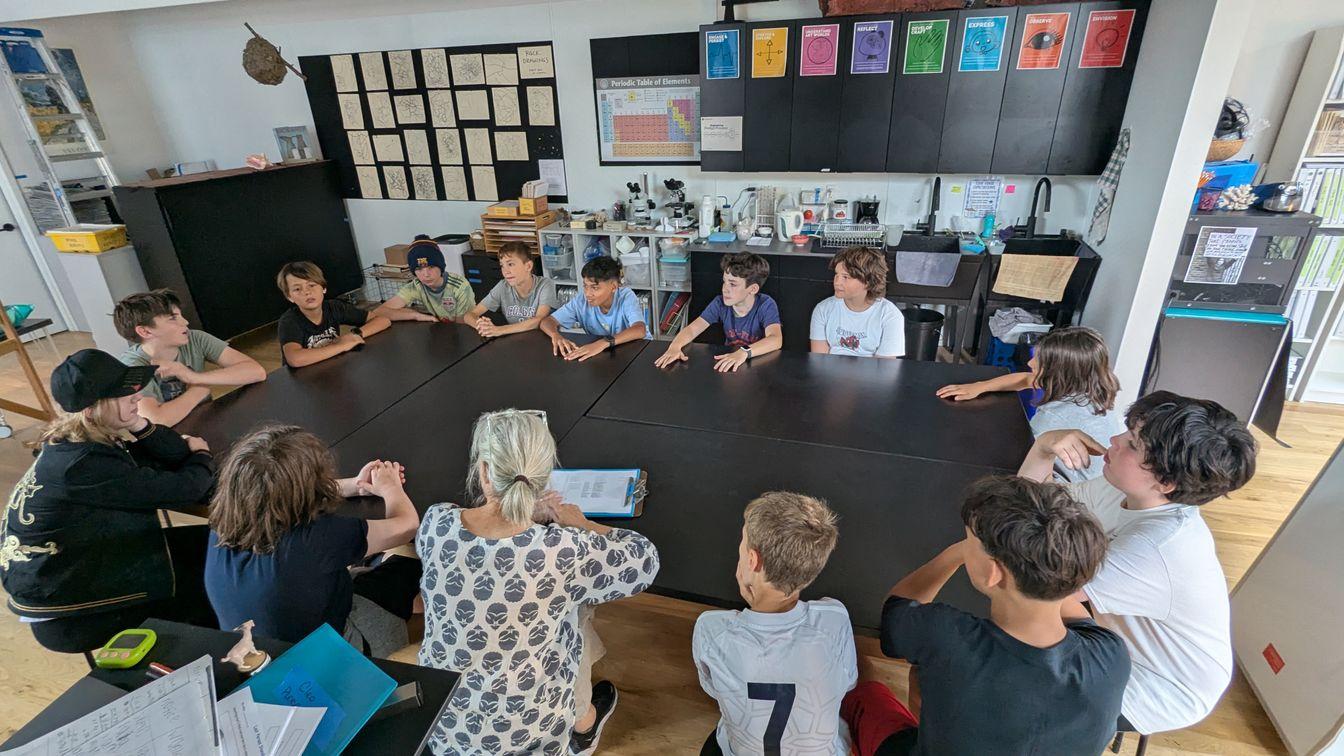
At the Montclair Co-op, every aspect of a child’s development is important to us. Your child will experience an environment that encourages academic excellence, independent and diverse thinking, imaginative and innovative ideas, support for one’s passions, and active social responsibility. Co-op students’ minds are stretched in many ways. New intellectual discoveries are made every day. Our program emphasizes experiential, integrated, hands-on learning.

Including even our youngest students, children are encouraged to take risks as a natural part of their rich academic experiences. We know, and wholeheartedly concur with child development experts, that children learn best when they are fully engaged in purposeful learning. Learning collaboratively, while also building on individual skills, helps each child solidly grasp age-appropriate concepts.

Programs at a Glance

Early Childhood

Our Early Childhood program emphasizes social growth, early literacy and math skills, music, and art, taught through play and integrated themes. Class trips are tied to the thematic curriculum.

Primary Grades

Our Primary School emphasizes continued development of social skills, such as self-confidence, independence, and creative expression. Core subjects like math, language arts, social studies, and science are both integrated into each grade’s thematic curriculum and taught as self-contained studies.

Upper School

In our upper school, students are encouraged to participate in meaningful service, activism, and community mentoring. This work complements their on-going explorations in math, science, literature, and historical and current world events.

The Key Elements of Progressive Education at the Co-op

Challenging academics, social education, hands-on projects, and creative expression through the arts define our multi-dimensional progressive education. At the Co-op, these are interconnected, forming an integrated curriculum. During the course of a child’s career at the Co-op, the balance shifts – but they remain in harmony. As children progress through the program, the areas become more differentiated, allowing separate intensive instruction in academics, the arts and social skills.

This integrated approach, based on a classroom theme, provides children a riveting context in which to learn and practice academic skills, to develop their understanding of social interaction, and to express their creativity. At its core, it teaches children how to think, beginning with what they already know and then provoking questions that lead them to seek out new knowledge.

Progressive educators have long emphasized providing students meaningful, integrated studies that connect with the real world and encourage both critical thinking and creativity. A growing body of research is proving that progressive education is more relevant than ever and qualities such as social-emotional intelligence are key to a successful life.

A Community of Learners

Excited About Education

Our aim is to foster our children’s natural inquisitiveness so that they may develop a life-long enthusiasm for learning. We see that spirit alive every day as our children come to school eager for the day ahead, whether in kindergarten or 8th grade. The pride and joy in learning is particularly tangible when classes hold their festivals after the completion of a long study, inviting the whole school to experience their work as they explain their process and share their amazing stories and art.

Academic Curriculum

Our goal is to educate children for a life of self-direction, intellectual curiosity, and a healthy interdependence. Our mission is to develop the academic abilities and encourage the emerging social responsibilities of each child, from the very youngest in the early childhood programs to the adolescents in our eighth grade. Each academic discipline contributes to this overall mission.

Language Arts

A fundamental part of the Co-op’s mission is to instill in children a love of reading, a sense of pride in their written work, and demonstrated mastery in both these areas of language arts. Reading is central to every aspect of Co-op life. The school equips each classroom with a comprehensive, age-appropriate book collection which offers a wide variety of literature, ranging from Big Books and picture books to fiction, non-fiction, poetry, biography, and autobiography. At all grade levels the reading program forms a critical component of the themed curriculum. At MCS every child is encouraged to view him or herself as an author. At every grade level, the writing program is enriched by the class thematic study.At each succeeding grade level, children delve more deeply into the writing process. They gain facility with the written word and become increasingly proficient at the mechanics of writing as they create, revise, edit and publish stories, poems, letters, essays, reports, and newspapers.

Mathematics

The Co-op math program is designed to give students both facility with mathematical problem solving as well as deep understanding of underlying mathematical concepts. The goal is for students to do more than get the “right” answer by memorizing a computational technique. The teacher also wants to know the students’ strategies for arriving at their answers, to ensure that children understand the fundamentals of numbers systems and geometry. Children work in whole-group settings, in small groups, and independently. As students progress through the upper school the curriculum has a problem-centered approach and every topic is explored from a variety of connected perspectives: graphs, tables, formulas, diagrams, models, and words.

Social Studies

Much of the infectious excitement found in the Co-op’s classrooms comes courtesy of social studies-based themes. Students at our school come to inhabit fully the study of history and culture; they design and build habitats from huts to hemispheres; they try on the roles and responsibilities of peoples as diverse as the African Masai and the Ancient Romans. Undertaking an in-depth study of world geography and global current events, our middle school students gain an understanding of the significant events occurring today and gain historical perspective of past world events and their immediate and long-term consequences. Students learn important research skills along the way. They learn how to investigate an historical topic and how to present their findings to others.

Science

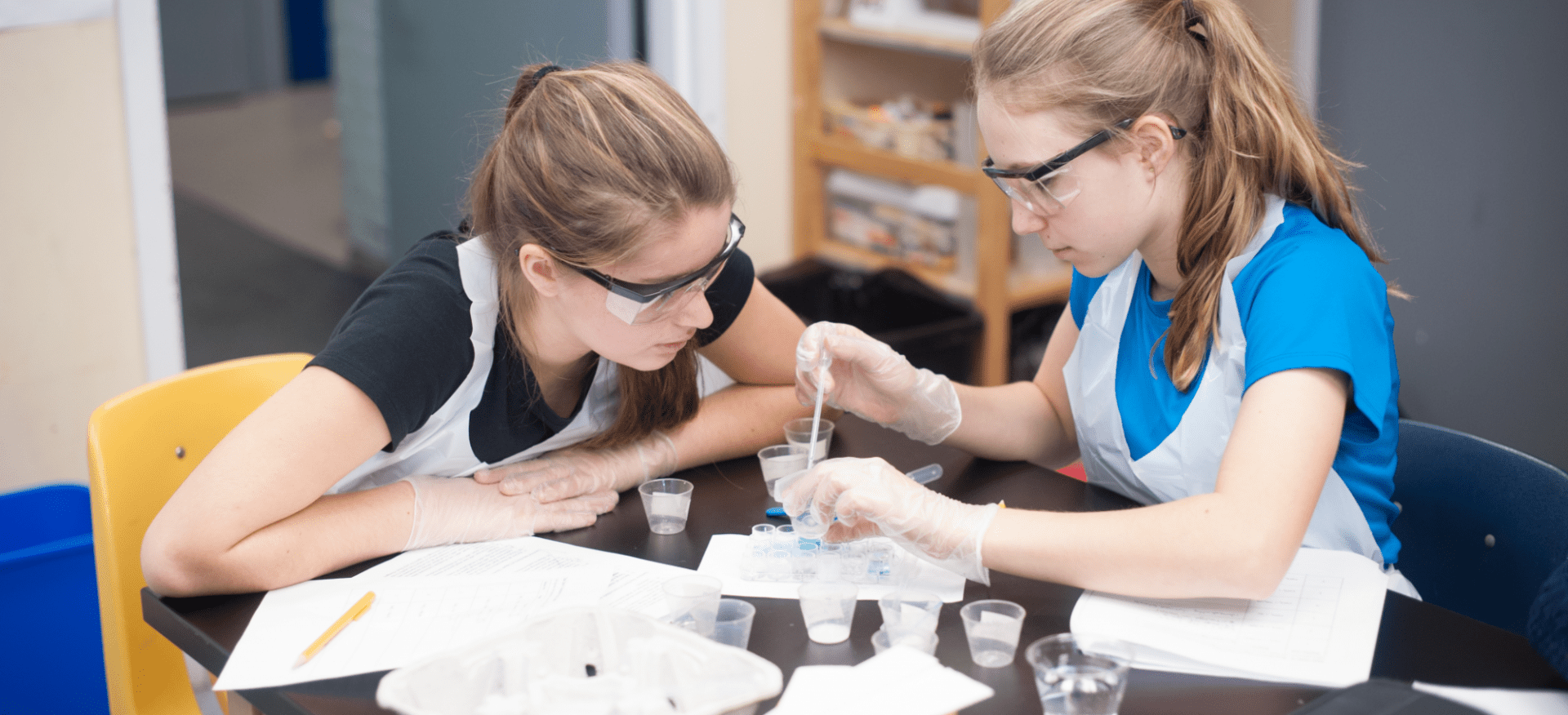
Questioning. Exploring. Discovering. Collecting. Constructing. Presenting. These are the bases of the Co-op science curriculum. Children are natural scientists. They learn best when their enthusiasm is tapped through hands-on exploration. The teacher’s role is not simply to expound but to guide the children as they make their own discoveries. At all grade levels, the science program emphasizes the natural world and instills in students a sense of responsibility to the environment. The scientific method is internalized as children learn to observe accurately, discuss and record information, look for patterns that allow for predictions and come to understand cause and effect. Science studies in the upper grades delve deeply into the scientific disciplines of earth science, life science, and physical science. Through formal laboratory work, various hands-on activities, long-term projects, and occasional field trips, students examine the foundational concepts of these fields.

Spanish


Technology

In recent years, technology has been integrated into young people’s lives to an unprecedented degree. The goal of the Coop’s technology department is to give our students a thorough education in the use and meaning of the technology that surrounds them. The teaching of technology is integrated into the theme curriculum for each grade—specific computer skills are taught when appropriate. We begin the formal teaching of computer-related skills (including touch typing, word processing, internet skills and image and video creation) in the third grade. We use technology as a tool for collaborative problem solving and explore the social and ethical issues and responsibilities that the cyber revolution has raised, such as plagiarism of copyrighted materials.

Art

Art permeates every classroom in the Co-op. Children of all ages are natural creators of art. Every new piece of work that children engage in and through which they express themselves is a form of art which reveals a piece of their thinking, technique, and view of the world. At the Co-op we cherish children’s natural artistry and, when they are ready, gradually teach them technique. The art children create here includes free-wheeling self-expression. In early childhood, artwork is done in the classroom, supervised (but not dictated) by the head teacher and assistant teacher. From Pre-K through eighth grades, children use our art studios and express themselves in a wide range of formats and mediums, including painting, printmaking, sewing, collage, sculpture, video and animation.

Music

Music in the early ages is experiential and an extension of daily classroom activities. Children in early childhood sing as they come to and begin their class meeting. The head teacher sings songs with the class throughout the day. Children create their own sounds, melodies, and rhythms; this often results in children orchestrating their own pieces. The music program has a strong focus on the individual student musician’s expression, creative thinking, and exploration of a variety of instruments, media, and technology. The students learn to listen critically for key elements of music including rhythm, pitch, dynamics, tone color and form. In addition, the students learn to express emotions and feelings through their own compositions and improvisations and to recognize them in others. Performance is encouraged as a tool for self-confidence building and individual expression.

Physical Education

Our goal is to help students develop awareness of their physical abilities, develop positive inclinations toward regular physical activity, and broaden their experience of physical activity to increase their enjoyment. The curriculum is designed to help children develop flexibility, strength, endurance, balance, creativity, and spiritual awareness through a variety of games and activities. Throughout the curriculum, cooperation and mutual support are expected and promoted. At every grade level class begins with a warm up (jogging, aerobics, dancing, or agility drills) as well as stretching and strengthening exercises, followed by age-appropriate physical activities and learning experiences.